research
Longer research posts: topics worked through in depth, from post-quantum cryptography and the history of AI to data engineering.
research
Security pipelines ask frontier LLMs millions of (basically) yes/no questions. I tested whether cheap decision models like Jev can triage HTTP responses instead: four models, three LLMs, one open harness. The answer is a qualified yes, plus a warning about what the gate throws away.
research
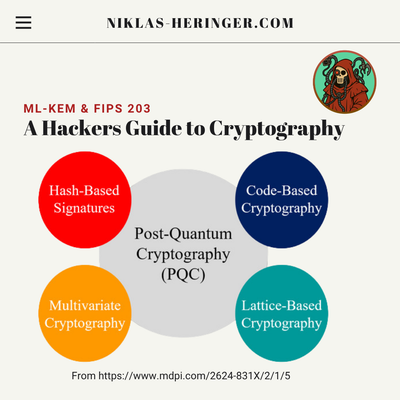
A Hacker's Guide to Post-Quantum Cryptography: ML-KEM & FIPS 203
Everything you need to understand the algorithm that's replacing RSA (in terms of Key Exchange), from polynomial rings to key encapsulation, with zero hand-waving.
research
Curing University Math Trauma: A Hacker's Guide to Cryptography
Remember sitting in university linear algebra, staring at the ceiling, begging the universe to tell you when you would EVER use this in the real world? Welcome. In this series, we take the seemingly useless math you slept through and show you how they secretly power the entire internet.
npts
Chaos Threat Actors: Why Corporations, Parents and Legal Systems Fail against Teenage Hackers
A discussion on Joe Tidy's "Ctrl + Alt + Chaos" and my takeaways. From the release of Julius Kivimäki to the rise of "Chaos-Evil" groups, I analyze company reactions to hacks, parents navigating the digital minefields and why the legal system might need a "cartel-style" overhaul.
artificial-intelligence
Statistical Dreams: The Intimate History of AI
From ancient automatons to the Transformer age, this is the story of how we taught machines to think. We'll dive into breakthroughs like the Perceptron, Backpropagation, and Attention, taking a critical look at AI's origins, its dangers, and where it's headed next.
go
More to Go: Clean Code & Core Concepts
A hands-on walkthrough of Go’s core building blocks. Arrays, slices, loops, functions, structs, and maps - explained with performance in mind. No fluff, just clarity.
go
Why Go? A Hacker’s First Dive into Golang
Ever wondered why Go keeps popping up in modern toolchains and cloud-native stacks? Here’s a hands-on dive into the syntax, philosophy, and quirks of Golang; written from a hacker’s point of view.
dagster
Data Engineering With Dagster Part Eight: Metadata
Dig into materialization metadata, inline visualizations, and best practices for asset observability using Dagster.
dagster
Data Engineering With Dagster Part Seven – Event-Driven Pipelines with Sensors
From Passive Pipelines to Reactive Workflows
So far, we’ve scheduled jobs based on time: “Run this every Monday” or
dagster
Data Engineering With Dagster Part Six – Partitioning & Backfills
Learn how to make your pipelines smarter by slicing them into manageable, date-based partitions and handling backfills like a pro.
dagster
Data Engineering With Dagster Part Five – Automating With Schedules
Dagster finally earns its “orchestrator” title - this part dives into jobs, asset selection, cron expressions, and how to wire everything into automated schedules.
dagster
Data Engineering With Dagster – Part Four: Resources, DRY Pipelines, and ETL in Practice
A deeper look at how Dagster handles reusable components like API clients and cloud connectors through resources - with best practices and cookie metaphors baked in.
dagster
Data Engineering With Dagster - Part Three: Definitions and Code Locations
How Dagster uses Definitions and Code Locations to scale cleanly across teams, assets, and environments.
dagster
Data Engineering With Dagster - Part Two: Dependencies, DuckDB, and Geo Heatmaps
Learning to wire assets together, load data into DuckDB, and build heatmaps with real NYC taxi data.
dagster
Data Engineering With Dagster - Part One: A Fresh Take on Orchestration
A student-hacker’s perspective on learning data engineering with Dagster: asset-centric thinking, orchestrator basics, and setting up the mental model.